 Turkistan News | East Turkestan & Uyghur News Doğu Türkistan & East Turkestan News | Uyghur Rights and China Reports


İlgili Makaleler

The Beijing administration continues to exploit the gray areas of international law and the sovereignty vulnerabilities of target nations while expanding its global infrastructure, logistics, and mining networks under the Belt and Road Initiative (BRI) [Chatham House – Rise of China’s Private Armies, Chatham House – Global Infrastructure Investment and Security Vulnerabilities]. In this installment of our series, we decrypt the network of “subcontracted militias” established by Chinese Private Security Companies (PSCs) in Africa to bypass their own domestic laws and evade legal liability for human rights violations committed on the ground.
1- Front Companies Bypassing the Weapons Ban
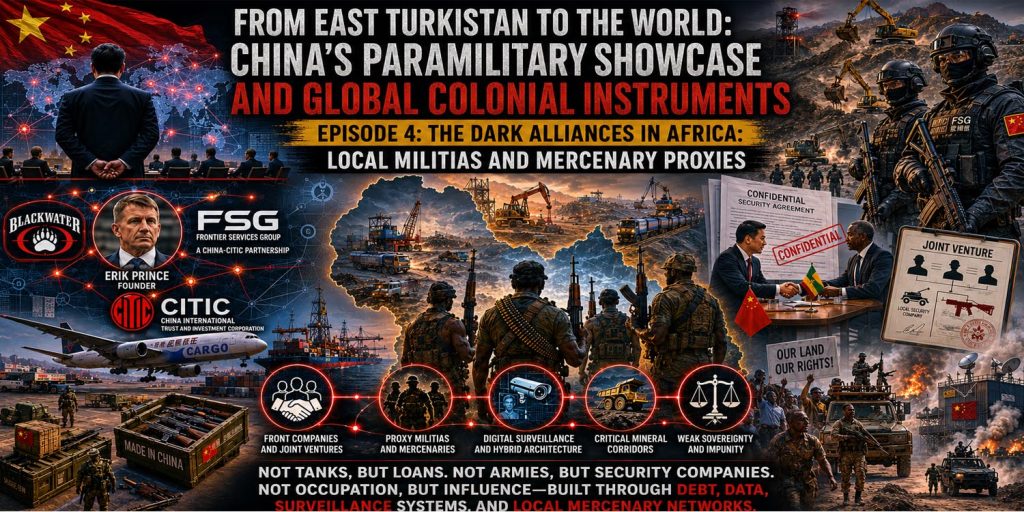
According to Chinese domestic law, it is strictly forbidden for Chinese private security firms (PSCs) to carry and use firearms abroad. The underlying reason for this rigid military restriction imposed by Beijing on its own companies stems from the Chinese Communist Party’s (CCP) doctrine that “armed force must remain solely under the monopoly of the state and the party.” China fears that private entities could amass uncontrolled armed power and evolve into a threat against the Beijing administration in the future. However, this domestic security paranoia has created a massive strategic contradiction, given that billions of dollars in global investments under the Belt and Road Initiative require armed protection on the ground. To bypass this rigid legal hurdle and avoid being labeled an “imperialist power deploying its military abroad” in the international arena, Beijing has developed an insidious formula: establishing joint ventures with local security companies in African countries [Chatham House – Rise of China’s Private Armies].
Legal Camouflage: These hybrid entities—which look local on paper but are entirely financed, logistically supported, and operationally managed by Chinese PSCs—ride on the back of local licenses and firearm carrying rights.
Uniformless Force: The most concrete example of this is Chinese PSC giants acquiring local aviation and logistics companies in Africa to establish front networks. Thanks to this hybrid logistics network, covert shipments of weapons, ammunition, and military equipment can be easily delivered to the local militias surrounding mining sites, entirely undetected by international oversight.
The Legal Detail of the Weapon Acquisition Ruse: Behind the establishment of local partnerships by Chinese PSCs lies a very specific operational reason based on “weapon registration manipulation” and local ownership deception. Because Chinese personnel cannot directly obtain firearm licenses, weapons and ammunition are registered on paper under the inventory of the partnered local front company. In the operational capillaries on the ground, this local license shield is exploited to the fullest; while official records list local company personnel as protection, it is the Chinese command echelon that directly pulls the trigger and issues the orders on the ground. Consequently, by manipulating the law enforcement statutes of the target nation, China turns that country’s legal framework into a cloak for equipping a private Chinese army on its own territory.
2- Subcontracted Militias and Dirty Operations
The most dangerous dimension of the formula is that it goes beyond regular security companies and takes on an entirely illegal structure. Chinese firms rent local criminal organizations, illegal armed groups, and militias in African states with weak sovereignty as “subcontracted mercenaries” to protect mining sites and railway lines, and to suppress the protests of local populations resisting the seizure of their lands.
The China Hybrid of Blackwater and Wagner (Global Doctrine Transfer and US Duplicity): While constructing its global military influence strategy, Beijing deeply analyzed the “corporate private mercenary” model presented to the world by the US via Blackwater and the “state-driven aggressive operation” method implemented by Russia via Wagner, hybridizing them to serve its own insidious goals. This situation also exposes one of the greatest scenes of duplicity in global geopolitics. The Washington administration claims on every international platform to defend the human rights of Uyghur Turks and stand against Chinese oppression. Yet behind the scenes, the very shadow and intellect of the US-based Blackwater are embedded in building the logistical and security infrastructure of the concentration camps and cyber-fascism centers established by China in East Turkestan. Indeed, the fact that Frontier Services Group (FSG), China’s largest paramilitary and PSC giant, was co-founded by Blackwater’s founder Erik Prince in partnership with Chinese state conglomerates (CITIC), and that this company played a role in the security logistics of the concentration camps in Xinjiang, is the most concrete and clear proof of how Western private military company technology was transferred to the Chinese state apparatus—and of the hypocritical share of American capital in the atrocities of East Turkestan.
The Contrast Between the Russian Wagner Group and the “China Model”: The international public only knows the Russian Wagner (now renamed Africa Corps) model when it comes to mercenaries. China’s model is far more insidious. Wagner directly stages coups and seizes assets with its own soldiers, whereas China remains behind the scenes by subcontracting local militias. Unlike Russia’s loud invasion prepared by using direct military force in Africa through the Wagner model, China operates an “invisible mercenary” model by staying behind the curtain and utilizing local militias. This allows Beijing to avoid being branded an imperialist military power while controlling the ground through the barrels of local criminal networks. Distinct from Russia’s Wagner-style direct military visibility, the Chinese model follows an invisible expansion strategy that is low-profile, camouflaged by economic investments, and driven through local partners. Thanks to this structure, Beijing can create actual spheres of influence on the ground while officially maintaining the appearance of an “investing partner.”
Devolution of Dirty Work: Dirty operations on the ground, such as illegal evictions, forced displacements, armed violence against local workers, and torture, are directly handed over to these local subcontractors.
Digital Surveillance and Hybrid Architecture: Security researchers point out that in certain China-linked projects, physical security networks and digital surveillance systems work in an integrated manner. Thanks to “Safe City” infrastructures, facial recognition cameras, and centralized data networks; field security, protest movements, worker mobilizations, and local social unrest can be monitored in real time. Thus, the Chinese model constructs a hybrid security architecture where armed security converges with digital tracking, data analysis, and paramilitary control on the ground.
Exporting the East Turkestan Doctrine (Rhetorical Camouflage): The Beijing administration has exported the rhetoric of “counter-terrorism” and “security operations”—which it utilizes to veil its systematic genocide and assimilation policies against Uyghur Turks in East Turkestan—directly into the African theater. Legitimate protests by local populations defending their lands and resisting the seizure of mines and logistics are labeled by the Chinese security apparatus as “elements of local instability” or “extremist threats.” It is through this rhetoric that the armed violence and torture inflicted by subcontracted militias upon local populations are presented to the international public as “operations to protect investments from terrorism.”
Plausible Deniability: Consequently, in the event of any crisis or international scandal, Chinese companies completely absolve themselves of international legal liability by stating, “It has nothing to do with us, it is an internal conflict between local tribes or groups.”
The Doctrine of Invisible Intervention: The Chinese model draws attention with its strategy of “invisible intervention,” aimed at creating permanent spheres of influence on the ground without giving the appearance of direct military intervention. Moving through local partners, subcontracted militias, commercial enterprises, and digital infrastructures, this structure allows Beijing to deny official responsibility during times of crisis while retaining economic and security control over the field.
3- Weak State Contracts and Unaccountable Violations
Security experts define this strategy of China as “Security Arbitrage.” Beijing escapes the strict legal frameworks of its own country to exploit the legal vacuums of states in Africa whose sovereignty has collapsed, camouflaging the human rights violations it generates there as legal commercial risk management. To protect this illegal security architecture and completely seal off the field, China signs secret state-level security contracts with governments whose institutional structures have crumbled, such as the Democratic Republic of Congo, Zambia, and the Central African Republic.
Law-Proof Shield: Hiding behind these weak state contracts, China-linked entities generate systematic rights violations against the local population.
The Armor of Impunity: These weak governments, reduced to virtual pawns on their own soil, are unable to launch a single legal investigation against these subcontracted militia networks and Chinese firms that exploit or massacre their own citizens, as they are paralyzed under the Chinese debt spiral and cyber-paramilitary siege.
Next-Generation Colonial Security Architecture: Some international security experts classify this model of China in Africa as a “neo-colonial security architecture.” In this framework, economic investments, digital infrastructure, security companies, and local subcontractor networks transform into hybrid instruments of influence that complement one another.
4- Critical Mineral Corridors and New-Gen Resource Wars
The regions where China’s security networks are most densely deployed in Africa are not accidental. Cobalt, lithium, copper, and rare earth element sites located in countries like the Democratic Republic of Congo, Zambia, and Mozambique are deemed critical raw materials for the global technology and defense industries.
Encircling the Chain of the Future: According to security experts, the concentration of Chinese PSCs in these regions is not merely for investment protection; it is a long-term strategic positioning move aimed at controlling the energy, battery, artificial intelligence, and military technology chains of the future.
The Global Objective of Supply Blackmail: The global objective of this paramilitary siege is to paralyze the green energy transition and defense industries of the Western world at the raw material level. The fact that these vital resources—essential for everything from smart missiles and fighter jets to electric vehicle batteries and AI chips—are de facto controlled by Chinese PSCs and subcontracted militias grants Beijing the capability to cut off the global supply chain at any moment. This dynamic represents a massive “supply blackmail” mechanism constructed to be weaponized against the Western alliance during moments of global geopolitical crisis, rather than a mere economic investment.
Critical Minerals and Global Tech Wars: Cobalt, lithium, copper, and rare earth elements are seen not just as commercial commodities, but as the foundational raw materials for AI systems, EV batteries, semiconductor manufacturing, defense industries, and modern warfare technologies. Therefore, security experts evaluate China’s mineral security strategy in Africa not as an economic investment policy, but as a long-term “strategic resource dominance” project aimed at shaping the future of global technological supremacy and the geopolitical balance of power.
The Blind Spot of International Law: According to security researchers, China’s hybrid security model exploits one of the greatest loopholes in existing international law mechanisms. By advancing through corporations, local partners, and subcontracted entities rather than a regular army, this system ensures that human rights violations, digital surveillance, and paramilitary repression cannot easily be attributed to direct state responsibility. This enables China to operate globally with low visibility but high impact capacity.
The New Arena of Geopolitical Competition: This new security order emerging in Africa is no longer just a matter of energy, minerals, or trade. According to security experts, this hybrid structure shaping up across the continent could become one of the central hubs of state sovereignty, digital control, natural resource dominance, and global geopolitical competition in the future. China’s invisible paramilitary model is evaluated as a next-generation architecture of influence that advances not with tanks, but with debt agreements, security companies, digital surveillance systems, and local subcontractor networks.
Editor’s Note and Strategic Summary:
This investigative report uncovers a next-generation colonial model taking shape within the framework of China’s expansionist policy and the global deployment of the China Global Invasion Plan. The Beijing administration creates financial dependency through the China Economic Trap doctrine, which holds target nations hostage via a debt spiral, and subsequently transforms this process into a military and intelligence siege. Operating through registration ruses and joint ventures on the ground, Chinese private security companies and the China paramilitary network infiltrating global channels bypass international oversight mechanisms, thereby elevating the risk of China Transnational Operations.
In this new order where elements of China’s internal security policy mutate into extraterritorial instruments, a Blackwater Wagner China Hybrid model has been engineered by copying Western private military company technologies. This insidious strategy aims to evade legal liability for human rights violations committed on the ground by utilizing local criminal networks and the African Proxy Militias network as fronts in countries with weak sovereignty. This Kuşak ve Yol Güvenliği (Belt and Road Security) architecture, which blockades critical mineral deposits and global supply chains, functions as a dangerous hybrid warfare doctrine converging finance, digital surveillance, and armed elements on the ground. Beyond threatening regional sovereignties, all these developments escalate East Asian geopolitical tension lines toward a global security crisis.
Turkistan News Center
RESOURCES:
1- Shell Partnerships Piercing the Weapons Ban
https://www.chathamhouse.org/publications/the-world-today/2019-02/rise-chinas-private-armies
https://www.chathamhouse.org/topics/chinas-belt-and-road-initiative-bri
https://www.chathamhouse.org/2018/07/managing-risk-build-better-belt-and-road
https://www.chathamhouse.org/2020/11/providing-community-based-security-africas-extractive-sector
https://www.chathamhouse.org/2019/02/chinas-growing-military-presence-abroad-brings-new-challenges
https://adf-magazine.com/2023/04/chinas-plans-to-expand-private-security-in-africa-could-pose-risks/
https://africacenter.org/spotlight/chinese-security-firms-spread-african-belt-road/
https://www.smallarmssurvey.org/
https://www.econstor.eu/handle/10419/248221
https://atlasinstitute.org/the-discreet-rise-of-chinese-private-security-companies-implications-for-africa/
2- Subcontracted Militias and Dirty Operations
https://www.econstor.eu/handle/10419/248221
https://atlasinstitute.org/the-discreet-rise-of-chinese-private-security-companies-implications-for-africa/?utm_source=chatgpt.com
https://www.ft.com/content/e6942960-19e9-11e7-bcac-6d03d067f81f?syn-25a6b1a6=1
https://www.miningmx.com/news/markets/37303-frontier-security-founder-erik-prince-registers-mining-subsidiary-in-drc/?utm_source=chatgpt.com
https://www.chathamhouse.org/2019/02/chinas-growing-military-presence-abroad-brings-new-challenges
https://www.csis.org/analysis/stealth-industry-quiet-expansion-chinese-private-security-companies?utm_source=chatgpt.com
https://www.crisisgroup.org/africa
3- Weak State Contracts and Unexplained Violations
https://www.oecd.org/en/topics/conflict-and-fragility.html
https://www.chathamhouse.org/2019/02/chinas-growing-military-presence-abroad-brings-new-challenges
https://www.brookings.edu/articles/china-africa-think-tanks-forum-china-broadens-soft-power-campaigns-in-africa/
https://www.sais-cari.org/
https://www.smallarmssurvey.org/
https://atlasinstitute.org/the-discreet-rise-of-chinese-private-security-companies-implications-for-africa/
https://africacenter.org/spotlight/chinese-security-firms-spread-african-belt-road/
https://www.orfonline.org/expert-speak/the-two-faces-of-china-s-security-engagement-in-central-africa
https://africacenter.org/spotlight/china-influence-africa-security-engagements/
4- Critical Mineral Corridors and Next-Generation Resource Wars
https://www.iea.org/reports/the-role-of-critical-minerals-in-clean-energy-transitions
https://www.ohchr.org/en/business-and-human-rights
https://www.csis.org/analysis/stealth-industry-quiet-expansion-chinese-private-security-companies?utm_source=chatgpt.com
https://www.csis.org/topics/critical-minerals
https://www.csis.org/analysis/building-critical-minerals-cooperation-between-united-states-and-democratic-republic-congo
https://features.csis.org/hiddenreach/china-critical-mineral-gallium/
https://pubs.usgs.gov/periodicals/mcs2024/mcs2024.pdf
https://www.africansecurityanalysis.com/reports/the-chinese-mining-surge-in-africa-strategic-impacts-and-national-risk-outlook
https://developmentreimagined.com/wp-content/uploads/2024/11/Africa-China-Cooperation-on-Critical-Minerals-15Nov-FINAL.pdf
https://www.brookings.edu/articles/china-in-africa-implications-for-u-s-competition-and-diplomacy/
https://www.brookings.edu/articles/chinas-role-in-supplying-critical-minerals-for-the-global-energy-transition-what-could-the-future-hold/
https://www.brookings.edu/articles/china-africa-think-tanks-forum-china-broadens-soft-power-campaigns-in-africa/
https://www.brookings.edu/articles/africa-can-provide-a-faster-solution-to-us-critical-minerals-needs/
https://www.hcss.nl/pub/2019/strategic-monitor-2019-2020/hybrid-conflict/
https://hcss.nl/report/reshaping-the-international-legal-order-chinas-strategic-use-of-lawfare-and-lessons-learned-for-europe/
https://hcss.nl/report/responding-to-chinas-hybrid-threats-strategic-postures-for-small-and-middle-powers/
https://www.cfr.org/china-digital-silk-road/
https://merics.org/en/chinas-new-international-paradigm-security-first
China’s Partnership Relations and Turkey-China Strategic Cooperation : https://dergipark.org.tr/tr/pub/avrasya/article/612657
#China #EastTurkistan #Uyghur #Africa #ChinesePSC #HybridWarfare #GrayZoneWarfare #DigitalAuthoritarianism #SafeCity #Huawei #Hikvision #Dahua #Paramilitary #ProxyMilitias #PrivateSecurityCompanies #BRI #BeltAndRoad #DebtTrapDiplomacy #Geopolitics #CyberSurveillance #StrategicResources #CriticalMinerals #GlobalSecurity #AfricaSecurity #ChinaInAfrica #ErikPrince #FrontierServicesGroup #WagnerGroup #HybridSecurity #DigitalControl
#ChinaSecurityModel #AfricanMiningWars #GlobalInfluenceOperations #StrategicPortControl #ChineseInfluence #ResourceGeopolitics #HybridInfluence #SecurityArbitrage #ProxySecurityForces #ChineseExpansion #GeoEconomicWarfare #DigitalSurveillanceState #AIControlSystems #AfricanResourceConflict #GlobalPowerShift #CriticalSupplyChains #NeoColonialism #MaritimeSilkRoad #InfrastructureControl #ParamilitaryNetworks #StrategicDependency #ResourceDominance #SurveillanceCapitalism #GlobalResourceWar #InvisibleExpansion #ChineseStateInfluence #EconomicCoercion #GeoStrategicCompetition #AIEnabledSurveillance
