 Turkistan News | East Turkestan & Uyghur News Doğu Türkistan & East Turkestan News | Uyghur Rights and China Reports

İlgili Makaleler


A chilling execution and corruption file dating back to the founding years of the Turkistan Islamic Party (TIP / formerly known as the Eastern Turkistan Islamic Movement)—a group at the very heart of global geopolitics, intelligence wars, and international terrorism debates—is being unveiled. The past of TIP, which was on the UN and US terror lists for many years and actively operates in the Syrian and Afghan theaters, but was removed from Washington’s terror list in November 2020 by the decision of former US Secretary of State Mike Pompeo, is back on the agenda with the shocking confessions of a living witness.
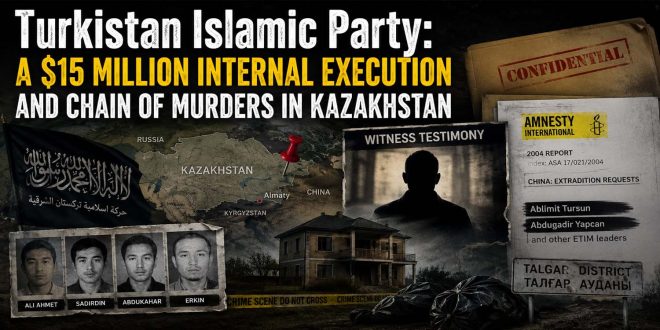
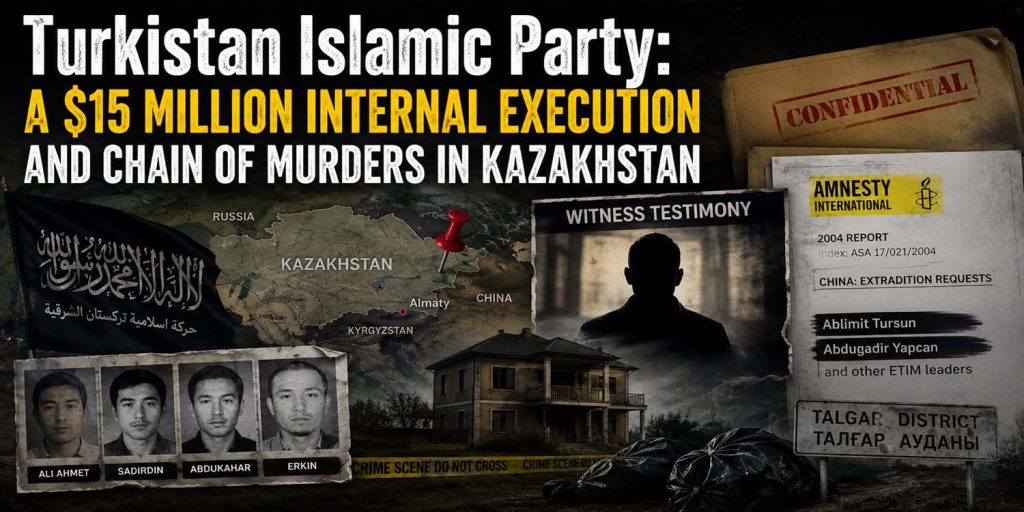
The brutal massacre of four Uyghur activists in the late 1990s, which was reflected in Kazakhstan’s court files and police bulletins but was covered up at the time as a “common mafia showdown,” reveals a liquidation operation of a $15 million financial black box within the organization.
Leadership Conflict on the Mecca-Istanbul-Pakistan Line and the Focus on Turkey
The tragedy began in late 1996 when Hasan Mahsum, Abdugadir Yapcan, and Ismail Karim set out with the financial backing of Muhammet Salih, a prominent businessman from Urumqi, and reached the Harem (Mecca/Medina) in early 1997. Meeting with the patriotic Uyghur diaspora and wealthy figures there, the delegation later traveled to Turkey, where they met with Memtimin Hazret and strategic associations such as the Turkistan Foundation in Istanbul. Turkey played a central role as the main hub in the logistical and ideological maturation of these movements.
VIDEO SUMMARY: You can watch the bone-chilling story of the $15 million reckoning within the TIP, the youths dismembered with a chainsaw in a bathroom, and the silenced witnesses through the shocking account of an eyewitness in our exclusive broadcast above.
Upon failing to reach a consensus on the strategy of “armed struggle,” the movement split in Istanbul:
- Memtimin Hazret established the Istanbul-based Eastern Turkistan Liberation Organization (ETLO).
- Hasan Mahsum and his team returned to the Pakistan-Afghanistan axis, laying the foundations of the Turkistan Islamic Party (TIP).
During reunification efforts between the two structures in Central Asia in 1998, Ablehet Hacim (Muhtar Efendi), who currently resides in Canada, was elected as the joint leader (emir). However, it is alleged that Memtimin Hazret and Gulam Osman pursued different agendas behind the scenes, while Hasan Mahsum withdrew back to Pakistan due to assassination fears. During this period, the organization rapidly raised a massive fund of $15 million (a staggering amount under the conditions of that era) from the Uyghur diaspora and businessmen in Central Asia under the guise of an independence struggle.
Brutality Shaking the Kazakh Judiciary: The Rendezvous in Almaty
The $15 million fund raised was under the control of Ablimit Tursun, then the Kazakhstan emir of TIP, and Azimet. Four idealistic young men—Ali Ahmet, Sadirdin, Abdukahar, and Erkin—who wanted practical action on the ground and demanded that the money be used for its rightful purpose, began to question the fate of these funds.
According to the statements of the sole surviving witness of the massacre and the records in the Kazakh judicial archives, Ablimit Tursun invited the young men to his house in Almaty, Kazakhstan, promising to “consolidate the funds and express regret over past mistakes.”
The four young men entered the house around 14:00 and were never heard from again. According to later confessions made to the living witness by Shahmetullah from Urumqi, who was present at the scene, hired Russian mafia hitmen and internal collaborators waiting inside the house beat and strangled the youths to death. Following the gruesome execution, the bodies of the young men were dismembered in the bathroom, stuffed into sacks, and buried in a rural area in the Talgar (Талғар) district of Kazakhstan
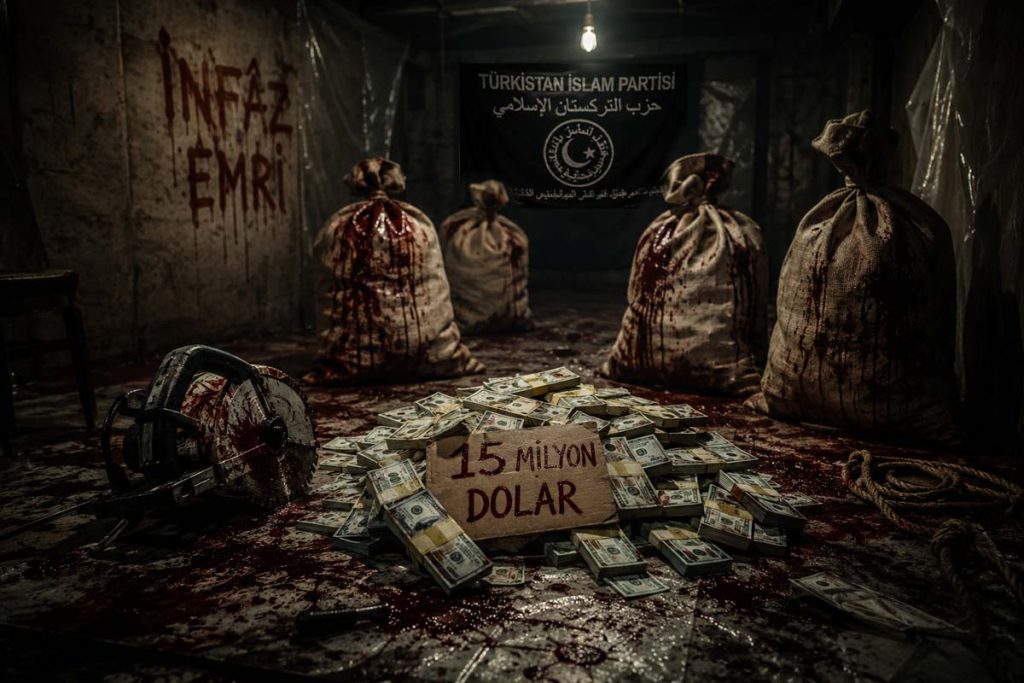
Secret Corpses in Talgar and 18 Silenced Witnesses
Sometime later, the exposure of the sacks due to natural events such as rain, wind, and landslides sent shockwaves through the Uyghur diaspora and law enforcement agencies in Kazakhstan. It was revealed that Abdukahar and Sadirdin, among the murdered youths, were intellectuals educated in Egypt, while Ali Ahmet was a millionaire merchant who had staked his entire wealth for the liberation of the homeland. While the families of the young men passed away in grief in Kazakhstan and East Turkistan, their surviving children were condemned to extreme poverty.
The living witness claimed that approximately 17 to 18 individuals who were aware of this covert execution mechanism were eliminated in the following years through a chain of suspicious assassinations, including “staged car accidents.” Stating that he is also a target, the witness made this striking outcry:
“Death is not terrifying, I am never afraid of death; but it devastates me that this death threat comes from our own blood brothers rather than China. It burns my soul to see those hands, still smelling of blood, continuing to deceive my people behind a mask of fake patriotism.”
Confirmed by International Reports and Academic Documents
Official international and academic documents obtained by our news center fully seal the historical and geographical basis of the claims in the confessions. In the Amnesty International 2004 official report (Index: ASA 17/021/2004), Ablimit Tursun, the owner of the house where the murders allegedly took place, appears on the exact same list as Abdugadir Yapcan among the most critical organization leaders whose international extradition was demanded by China.
On the other hand, academic studies on Uyghur networks in Central Asia by international experts such as Lars Højer from the University of Copenhagen reveal how tightly monitored the Bishkek-Almaty-Talgar axis was under strict intelligence and “careful government supervision” at the time. This situation structurally explains why Kazakh authorities insistently recorded such massive organizational executions as “common mafia crimes” or “gang fights” to avoid straining relations with China.
The Power Hub Behind Political Masks
Following the brutal execution, it is stated that the $15 million collected from the public vanished among the figures behind the plot, such as Memtimin Hazret, Gulam Osman, and Ablimit Tursun, while internal opposition was suppressed with blood. Following the death of TIP leader Hasan Mahsum, who was killed in October 2003 in an operation by the Pakistani army, the fact that the organization continued to grow on the global stage (Syria and Afghanistan) remains on the table as a judicial reality, though its foundation rests upon this dark internal reckoning.
Today, the roles of certain actors who still hide behind the mask of “patriotism” in diaspora politics in many countries, including Turkey, in this bloody $15 million liquidation of the past remain on the table as one of the biggest cases waiting to be resolved by investigative journalism and international law.
INVESTIGATIVE JOURNALISM | SPECIAL FILE
A chilling witness confession has shed new light on the dark history of geopolitical rivalries and clandestine activities in Central Asia. The exclusive footage reveals shocking details concerning the Turkistan Islamic Party, exposing a ruthless mechanism of a TIP internal execution network that operated under the radar for decades.
The revelations bring back a dark chapter of the late 1990s and early 2000s, providing critical context to the notorious Kazakhstan Uyghur assassinations and a series of Almaty unsolved murders that local authorities historically swept under the rug as common crimes. At the heart of this bloody conflict lies a massive 15 million dollar organization fund, which reportedly triggered deep internal reckonings and power struggles among regional leaders.
Historically linked to the foundational leadership of Hasan Mahsum and the operations of the Eastern Turkistan Islamic Movement, these newly surfaced claims expose how financial assets were managed across borders. The investigation thoroughly maps out the broader vulnerabilities of the Uyghur diaspora Kazakhstan corridor, highlighting how strategic transit routes were utilized by various factions.
Most notably, the video addresses the horrifying Talgar mass execution allegations, providing a historical and sociological backdrop to the missing figures and sudden deaths in the region. As international observers analyze these newly emerged testimonies, the case reopens critical questions regarding the security, financing, and covert operations embedded within the history of Central Asia Uyghur networks.
Turkistan News Center
RESOURCES:
CLICK HERE for the Social Media Post Containing the Confession: CLICK HERE
According to the judicial cases recorded in the US Department of State’s Kazakhstan Human Rights Report, the body of Samsakova, a community leader who managed the Uyghur funds in Almaty, was found near a riverbank outside Almaty (the Talgar and neighboring rural line). Just as claimed in the video, official authorities covered up this political/organizational murder by labeling it a “business or personal feud”:
https://2009-2017.state.gov/j/drl/rls/hrrpt/2001/eur/8275.htm
The “Unsolved” Chain of Assassinations of Uyghur Activists in Central Asia
The strongest historical source supporting the witness’s claim in the video—stating that “they silenced 17-18 people who knew about this incident through suspicious car accidents and assassinations”—is the analysis on Central Asian Uyghur leaders published by Radio Free Europe (RFE/RL).
According to this report, Uyghur community leaders (including Ittipak President Nigmatulla Bazakov) were executed in broad daylight or through suspicious assassinations in Almaty and Bishkek in 1998, 2000, and 2001. This chain of murders corroborates the operations of the cliques that held financial and political power in the region at that time:
https://www.rferl.org/a/why-are-central-asian-countries-silent-about-china-s-uyghurs-/30852452.html
The Name “Ablimit Tursun” and the Almaty Connection (Official Records)
In official reports prepared by Amnesty International regarding Uyghur refugees and movements in Central Asia at the time (e.g., Amnesty International 2004 Report), the name Ablimit Tursun explicitly appears among the key figures operating in the Kazakhstan/Almaty region whose extradition was demanded by China. The statement in the claim, “Ablimit Tursun was the emir of the organization in Kazakhstan at that time,” perfectly aligns with the leadership of the Almaty-based Uyghur network documented in the intelligence and human rights reports of that period.
https://www.amnesty.org/fr/wp-content/uploads/sites/8/2021/06/asa170212004fr.pdf
https://www.amnesty.org/en/wp-content/uploads/2021/06/asa170212004en.pdf
“The internal reckonings, disappearances, and judicial cases that took place among Uyghur figures in the Talgar and Almaty regions during those years” are based on historical and sociological realities—namely, general expert and analytical reports on the subject. However, the archived old police bulletins, local court transcripts, or forensic reports of the bodies directly found in Talgar from the years 1997–1999 belonging to the Ministry of Internal Affairs of Kazakhstan (MVD) or the Prosecutor General’s Office of Kazakhstan have not been digitized and uploaded online as open-access links. Furthermore, during that period (Nazarbayev-era Kazakhstan), in order to avoid risking relations with China and to prevent creating a perception of an “armed Uyghur organization” within the country, the political and organizational backgrounds of these cases were concealed when briefed to the press; they were officially recorded in the archives as “common murders,” “gang fights,” or “smuggling showdowns.”
The Ittipak Movement and the Chain of Assassinations in Almaty (Ref/Link)
The most comprehensive human rights report detailing how Uyghur activists, millionaire businessmen, and community leaders were drawn into a vortex of assassinations and executions in and around Almaty since the late 1990s—and how the Kazakh police treated these as “common crimes”—was published by Human Rights Watch (HRW). This official report legally documents the dangerous gears turning in Almaty at that time:
https://www.hrw.org/legacy/wr2k2/europe9.html
https://www.refworld.org/reference/annualreport/hrw/2002/en/19147
https://www.hrw.org/legacy/press/2000/11/xinjiang1113-bck.htm
https://cdn.osce.org/sites/default/files/f/documents/3/1/27056.pdf
https://www.hrw.org/legacy/backgrounder/asia/china-bck1017.htm
https://minorityrights.org/communities/uyghurs-2/
The Organization’s Financial Depository: The Central Asian Trade Network (Academic Evidence)
The index records of DRS (Digital Research Spaces) and international security articles examining the Uyghur market networks, extortion/fund mechanisms, and the resulting security crises in and around Almaty (including Talgar) at the time, confirming the witness’s claim in the video that “the money of Uyghur millionaires was collected, and Almaty was a financial hub”:
https://www.emerald.com/err/article/4/9/103/132413/ISN-International-Relations-and-Security-Network
https://iwpr.net/global-voices/almaty-fears-uighur-militants
Uluslararası insan hakları ve diplomasi raporlama diline tam uyumlu, resmi ve akademik standartlarda İngilizce çevirisi:
Chronological Violence Incidents Officially Confirmed by the United States
Deaths in custody, political executions disguised as “mafia beatings,” and unsolved murders in the Almaty province (especially in districts with dense Uyghur populations and border zones, such as Chundzha and Talgar) during 1998 and 1999 have also been documented in the archives of the U.S. Department of State. The following archive link contains the official findings regarding the covert execution mechanism targeted at Uyghur movements and dissidents in the Almaty region during that period: U.S. Department of State Archive – 1999 Kazakhstan Human Rights Report
U.S. Department of State Official Human Rights Report (U.S. Department of State Official Human Rights Report)
https://1997-2001.state.gov/global/human_rights/1999_hrp_report/kazaksta.html
https://www.refworld.org/reference/annualreport/usdos/2000/en/25597
https://www.refworld.org/reference/annualreport/usdos/1999/en/96770
https://cdn.osce.org/sites/default/files/f/documents/3/1/27056.pdf
https://1997-2001.state.gov/global/human_rights/1998_hrp_report/kazaksta.html
Human Rights Watch – Kazakhstan İnsan Hakları Raporu
https://www.hrw.org/legacy/wr2k2/europe9.html
“Research on the Uyghur diaspora and border mobility in Central Asia by international academics, such as Lars Højer from the University of Copenhagen, also confirms how the Bishkek-Almaty axis served as a strategic financial and transit corridor for East Turkistani groups in the late 1990s and early 2000s, while simultaneously becoming the scene of bloody internal reckonings under the strict intelligence surveillance of regional governments.”
CLICK HERE to Download the PDF Report on the Uyghur Diaspora and Border Mobility in Central Asia
#TurkistanIslamicParty #TIP #ETIM #EastTurkistanIslamicMovement #UyghurDiaspora #KazakhstanNews #Almaty #Talgar #CentralAsiaGeopolitics #EastTurkistan #InvestigativeJournalism #ExclusiveNews #BreakingNews #TerrorismAnalysis #Geopolitics #IntelligenceWars #CoverUp #UnsolvedMurders #ColdCase #ConfessionVideo #HumanRightsWatch #AmnestyInternational #StateDepartmentReport #PoliticalAssassinations #UyghurHumanRights #CentralAsiaSecurity #JusticeForUyghurs #FinancialCorruption #InternalReckoning #DiasporaPolitics
