 Doğu Türkistan News, East Turkestan News Doğu Türkistan Haberleri , East Turkestan News , Türkistan News, Çin Zulmü, Çin Haberleri, Toplama Kampları, Soykırım, Uygur Haberleri, Uygur Türkleri

İlgili Makaleler


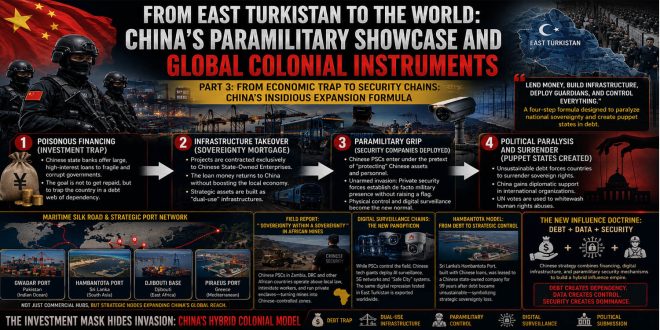
“For many years, the global financial system has criticized the debt-inducing policies of Western institutions. However, the Beijing administration has introduced a brand new and far darker doctrine to international financial literature: ‘Debt-Trap Diplomacy.’ This strategy is not merely a pursuit of economic gain; it is a calculated blueprint to paralyze the national sovereignty of target nations through a debt spiral, transforming them step-by-step into cyber-paramilitary colonies.”
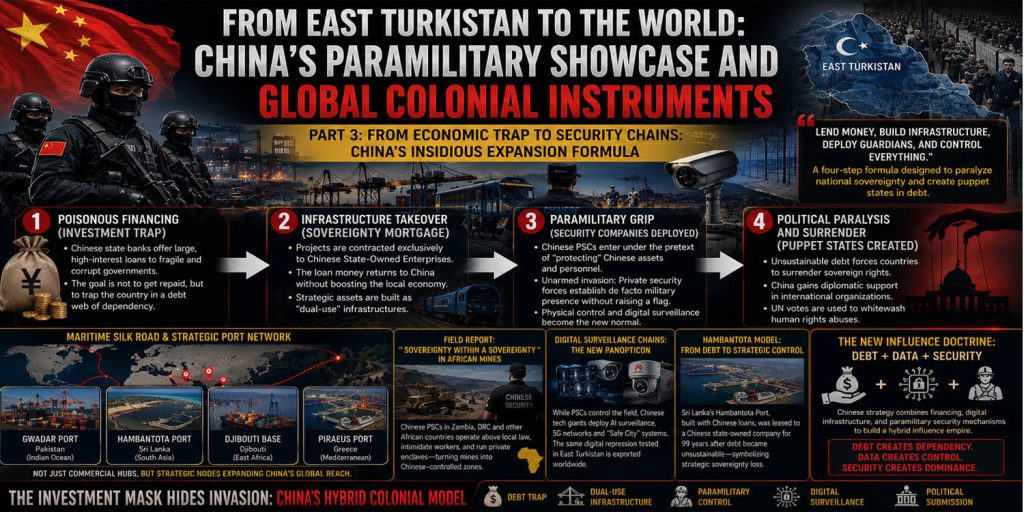
“This system, implemented by the Chinese Communist Party (CCP) under the ‘Belt and Road Initiative’ (BRI), does not feed on accidental crises; on the contrary, it is an insidious four-stage invasion formula engineered from the very beginning to yield military and intelligence outcomes.”
1- Toxic Financing (The Investment Trap)
“It all begins with ‘large and attractive’ loan packages offered by Chinese state banks (such as Exim Bank and China Development Bank) to fragile, corruption-ridden countries or those excluded from Western financial markets.
Setting the Trap: Unlike international market standards, these loans are highly opaque debt contracts containing secret clauses and exorbitant interest rates.
Strategic Objective: China is well aware from the outset that the recipient country cannot repay this debt. The objective is not to recover the money, but to hold the debtor country hostage at the negotiating table.
‘According to critics and certain Western strategic analysis centers, China sustains this financing model despite foreseeing in many instances that the debts will become unsustainable.'”
2- Surrender of Infrastructure (The Sovereign Mortgage)
“The massive loans granted come with a sole condition: the tenders for the projects (ports, mines, railways, power plants) must be awarded exclusively to Chinese State-Owned Enterprises (SOEs) without exception.
Return of Capital: The money provided as a loan never actually enters the economy of the target country; it flows directly back into the coffers of Chinese construction and technology giants.
Building Trojan Horses: The most critical logistical and strategic nodes of the target country are constructed by Chinese engineers utilizing ‘dual-use’ architectures designed to serve the future interests of the Chinese state.”
“Civilian”-Looking Dual-Use Infrastructures: In international security literature, many Belt and Road projects are classified as “dual-use infrastructure.” Although officially constructed for commercial purposes, facilities such as ports, telecom networks, logistics hubs, and energy corridors are heavily debated as assets that can provide military logistics, intelligence, and strategic access during times of crisis.
The Maritime Silk Road and the Strategic Chain of Ports
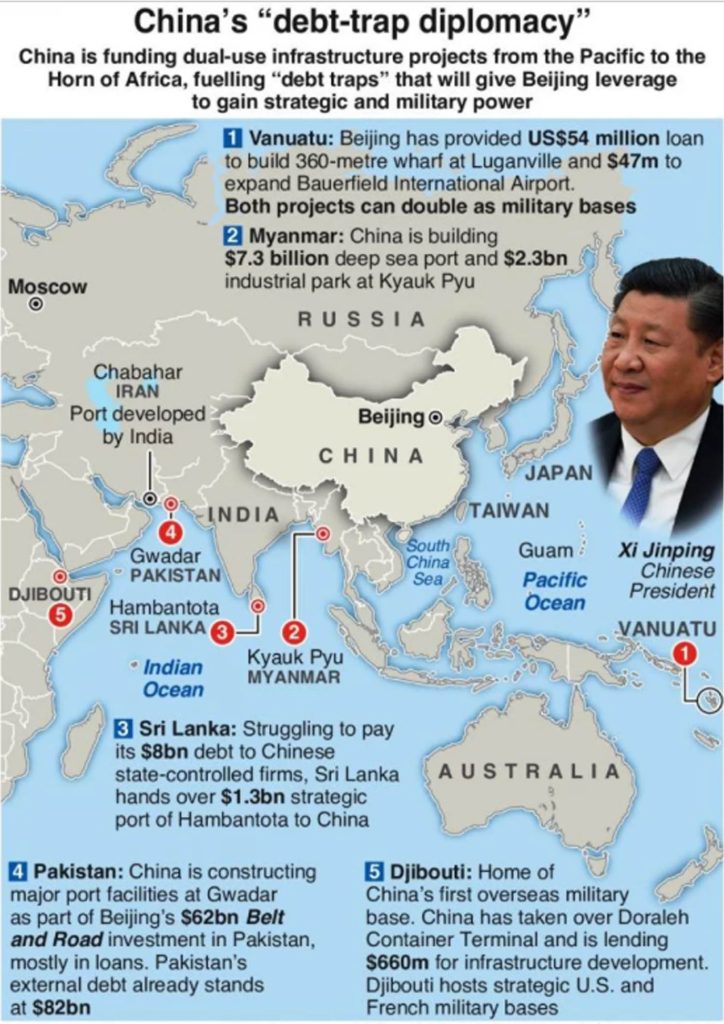
According to experts, the most critical pillar of China’s Belt and Road strategy is the “Maritime Silk Road.” Hubs such as the Gwadar Port in Pakistan, Hambantota in Sri Lanka, the military/logistics base zone in Djibouti, and the Port of Piraeus in Greece are viewed not merely as commercial centers, but as strategic choke points that expand China’s global reach.
3- The Paramilitary Trap (Deployment of Security Companies)
Once the economic and physical infrastructure is complete, the formula advances to its most dangerous and insidious stage. Using the security vulnerabilities of local governments or the pretext of ‘protecting Chinese workers and investments,’ the Beijing administration deploys its own paramilitary forces onto the ground: Chinese PSCs.
The Mask of Legitimacy: Entities such as DeWe Security, FSG, or Huaxin ZhongAn embed themselves into ports, mining sites, and logistics corridors under the guise of ‘innocent guards protecting commercial assets.’
Uniformless Occupation: While sending a regular army (the PLA) into a country constitutes an ‘invasion’ under international law, deploying thousands of Chinese paramilitary personnel under the label of ‘private security’ to critical bases is camouflaged as a commercial contract. Thus, China establishes de facto military garrisons in target nations without paying any diplomatic price.
Field Report: ‘Sovereignty Within Sovereignty’ in African Mines
The most brutal examples of this uniformless occupation are unfolding across the African continent. The deployment of Chinese PSCs in critical copper and cobalt mines in Central African nations like Zambia and the Democratic Republic of Congo—where they completely bypass local law enforcement, enforce their own internal regulations, and commit human rights violations against local workers—proves that these civilian-looking entities have effectively turned into mini-Chinese colonial garrisons within sovereign states.
The Digital Surveillance Shackle: The New-Gen Panopticon on the Ground
While Chinese PSCs maintain physical control on the ground with rifles, Beijing’s tech giants simultaneously infiltrate the digital capillaries of the projects. “Safe City” conceptualized AI-driven facial recognition systems (Hikvision, Dahua) and 5G networks (Huawei)—tested and perfected by China as a laboratory in East Turkestan—are installed into the critical infrastructure of the debtor nation under the banner of “security integration.” Consequently, the civilian and commercial-looking physical occupation is thoroughly sealed by a digital surveillance shackle that replicates the open-air prison of East Turkestan.
4- Political Paralysis and Capitulation (The Building of Puppet States)
The final stage of the formula is the evolution of economic dependency into complete ‘Security Dependency,’ followed by total political servitude. Countries that find themselves unable to meet their debt installments are forced to forfeit their sovereign rights upon returning to the negotiating table.
The Hambantota Model (From Debt to Strategic Control): Sri Lanka’s Hambantota Port, built with Chinese loans, has become one of the symbolic case studies of ‘debt-trap diplomacy’ debates. Following the country’s inability to sustain its debt, the transfer of the port’s operating rights to a Chinese-linked company for 99 years stands as the most concrete proof of economic dependency mutating into a loss of strategic sovereignty.
The East Turkestan Connection: Funded Silence on Atrocities
The most horrifying geopolitical consequence engineered by this insidious formula is that these countries, strangled by debt and besieged by cyber-paramilitary networks, are transformed into international accomplices of China.
African, Central Asian, and Balkan states—crushed under Chinese debt, losing their ports to Chinese PSCs, and surrendering their digital infrastructure to Huawei/Hikvision networks—have been reduced to puppet entities unable to utter a single word against the genocide, digital fascism, and concentration camps inflicted by Beijing upon Uyghur Turks in East Turkestan.
Beijing systematically uses the votes of these bound states at United Nations (UN) podiums as pawns to whitewash its own human rights violations. In fact, even in votes called at the UN Human Rights Council merely to ‘discuss’ the atrocities in East Turkestan, China utilizes the votes of these debt-trapped African and Asian nations as a unified bloc to defeat the motions, thereby legitimizing the persecution through the very signatures of these victimized nations.
The Next-Generation Doctrine of Influence: Debt + Data + Security
According to security experts, the Chinese model is no longer viewed solely as an economic investment strategy, but as a next-generation hybrid doctrine of influence where financing, digital infrastructure, and paramilitary security mechanisms converge. In this model, loans create economic dependency, digital infrastructure yields data dependency, and private security companies secure physical spheres of influence on the ground.
This comprehensive investigative report uncovers the strategic mechanics behind China Global Invasion Plan, analyzing how Beijing’s domestic control methods are being weaponized into a global doctrine of expansion. The study reveals that the initial leverage is established through China Economic Trap, which systematically targets vulnerable nations to compromise their national sovereignty. Once financial dominance is secured, Chinese paramilitary demonstration tactics and the deployment of Private Security Companies (PSCs) serve as tools for China Transnational Operations, establishing de facto military presence worldwide.
Furthermore, the report highlights the grim origins of this hybrid doctrine, emphasizing that the digital and physical surveillance systems exported globally were first perfected during the brutal Xinjiang security operation. Driven by China’s internal security policy, these aggressive enforcement measures have led to a severe systemic oppression of Uyghur Turks, sparking an unprecedented Uyghur human rights crisis that continues to draw condemnation from international bodies. As Beijing expands its footprint from Central Asia to Africa and the Balkans, China’s expansionist policy not only threatens territorial sovereignty abroad but also dramatically intensifies East Asian geopolitical tension, reshaping the global security architecture.
Turkistan News Center
REFERENCES :
AidData / William & Mary College (Global China Debt Database) :
https://www.aiddata.org/china
https://www.aiddata.org/data/chinas-global-loans-and-grants-dataset-1-0
https://china.aiddata.org/
https://www.aiddata.org/how-china-lends-archive
Harvard Kennedy School(Foundational Analysis of Debt-Trap Diplomacy) :
https://www.hks.harvard.edu/centers/mrcbg/publications/awp/awp248
https://www.belfercenter.org/sites/default/files/pantheon_files/files/publication/Debtbook%20Diplomacy%20PDF.pdf
https://www.belfercenter.org/publication/debtbook-diplomacy
Kiel Institute for the World Economy (Decryption of Secret Contracts)
https://www.kielinstitut.de/publications/kiel-institute-highlights/how-china-lends-a-rare-look-into-100-debt-contracts-with-foreign-governments/
https://www.kielinstitut.de/publications/news/how-china-collaterizes-new-report-reveals-hidden-structures-in-global-lending/
https://www.cgdev.org/sites/default/files/how-china-lends-rare-look-100-debt-contracts-foreign-governments.pdf
https://www.aiddata.org/publications/how-china-lends-2-0-research-brief
Chatham House(The Security Dimension of the Belt and Road)
https://www.chathamhouse.org/publications/the-world-today/2019-02/rise-chinas-private-armies
https://www.chathamhouse.org/2020/08/debunking-myth-debt-trap-diplomacy
https://www.chathamhouse.org/topics/chinas-belt-and-road-initiative-bri
https://www.chathamhouse.org/2026/05/uk-cant-break-critical-mineral-links-china-it-can-understand-its-vulnerabilities
HASTAG : #ChinaNews #EastTurkestan #Xinjiang #UygurTürkleri #UyghurCrisis #ChinaSecurity #Paramilitary #HumanRights #HumanRightsAbuse #UyghurGenocide #ChinaPolicy #Geopolitics #GlobalNews #WorldPolitics #BreakingNews #NewsUpdate #InternationalRelations #SecurityStudies #SurveillanceState #ChinaXinjiang #Turkestan #CentralAsia #FreedomRights #MinorityRights #PressFreedom #CivilRights #HumanitarianCrisis #ConflictZone #AsiaNews #InvestigativeJournalism
#BeltAndRoad #DebtTrapDiplomacy #GrayZoneWarfare #HybridWarfare #Geopolitics #GlobalSecurity #NationalSecurity #ForeignPolicy #EconomicImperialism #Sovereignty #ChinesePSCs #Paramilitary #FrontierServicesGroup #DeWeSecurity #PrivateSecurityCompanies #ShadowArmy #PLA #MilitaryStrategy #DefenseAnalysis #TechnoAuthoritarianism #DigitalFascism #AISurveillance #SafeCity #MassSurveillance #Huawei #Hikvision #Dahua #CyberEspionage #DataSovereignty #Panopticon #UyghurGenocide #EastTurkistan #HumanRights #UnitedNations #Uighurs